
Heat Exchanger Cleaning in Tulsa, Oklahoma
Tulsa is one of the most industrially active cities in the mid-continent region. Home to major refinery operations and a long history in oil and gas production, the city runs on equipment that cannot afford to fail. Heat exchangers sit at the center of that equipment — moving thermal energy through refineries, chemical plants, and processing facilities around the clock. When fouling, scale, or blockage cuts into their performance, the effects ripple fast: rising energy costs, reduced throughput, unplanned shutdowns.
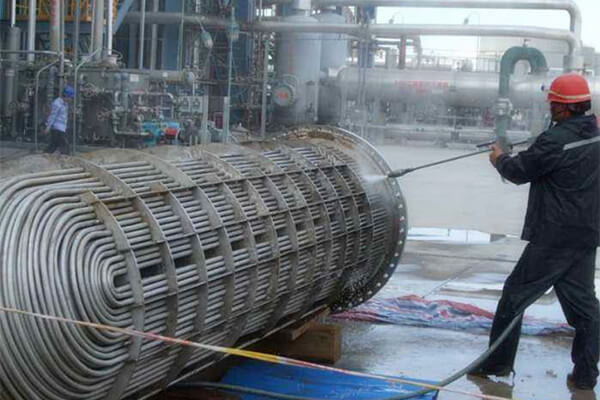
Rock Hill Industrial provides heat exchanger cleaning in Tulsa, OK for facilities that need the job done right, with zero shortcuts. We use high-pressure hydro blasting at 20,000 to 40,000 PSI to remove scale, hydrocarbon deposits, biological fouling, and hard-packed debris from shell-and-tube exchangers, plate exchangers, and air-cooled units. Where chemical contamination or stubborn buildup requires a different approach, we deploy chemical cleaning as a complementary method.
Call us today at 844-762-4455 or visit our contact page to schedule service in Tulsa.
What Is a Heat Exchanger and Why Does It Foul?
A heat exchanger transfers thermal energy between two fluid streams without mixing them — essential in oil refining, gas processing, HVAC systems, and chemical manufacturing. Over time, the internal tubes, plates, and channels accumulate:
- Scale and mineral deposits from hard water or process fluids
- Hydrocarbon fouling — wax, crude oil residue, and coke buildup
- Biological growth in cooling water systems
- Corrosion byproducts — iron sulfide, rust, and oxidation layers
- Process debris — catalyst fines, sand, and solid particulates
Even a thin layer of fouling — as little as 1/16 of an inch — can reduce heat transfer efficiency by 20% or more. Left untreated, fouled exchangers force your system to compensate with more energy, increasing operating costs and stress on downstream equipment.
Oklahoma’s oil and gas sector, its heavy chemical manufacturing corridor along the Arkansas River, and its agricultural processing facilities all depend on heat exchangers running clean. We understand the operational rhythms of these industries because we work in them every day.
Why Heat Exchanger Cleaning Matters in Tulsa’s Industrial Market
Tulsa’s refinery operations process over 100,000 barrels of crude per day. Facilities of that scale run heat exchangers in crude preheating, fractionation columns, product cooling loops, and amine treating units. Fouling in any one of these locations reduces thermal efficiency, forces the system to compensate with more energy, and creates pressure drop across tubes and bundles.
Left unaddressed, fouling leads to:
Tube wall corrosion that shortens equipment life. Pressure imbalances that stress welds and gaskets. Reduced heat transfer coefficients that push energy costs up 10 to 20 percent. Forced unit shutdowns during turnarounds that were not scheduled.
Regular cleaning keeps exchangers operating at rated capacity, extends tube bundle life, and gives maintenance teams a clear picture of the unit’s internal condition before problems escalate.
Our Heat Exchanger Cleaning Process
When Rock Hill Industrial cleans a heat exchanger in Tulsa, we begin with a full inspection of the unit’s current condition — checking for scale deposits, corrosion, tube plugging, and structural wear. That assessment shapes the cleaning method we apply.
For most refinery and gas plant applications, high-pressure hydro blasting is the primary method. We rod out tubes using water at pressures up to 40,000 PSI, breaking apart scale, coke deposits, and biological growth without abrading metal surfaces. For tightly fouled shell sides and fin sections, we use 3D tank cleaning heads to reach areas a straight lance cannot access.
When hydro blasting alone cannot fully restore performance — particularly in exchangers affected by carbonate scale, iron sulfide, or organic fouling — we combine it with chemical cleaning to circulate a targeted solution through the unit and dissolve what pressure alone cannot remove.
After cleaning, we pressure test the unit before returning it to service. We document conditions before and after so your maintenance records are complete.
Industries We Serve in Tulsa
Tulsa’s industrial base includes petroleum refining, natural gas processing, aerospace manufacturing, and chemical production. Our heat exchanger cleaning teams work across all of these sectors.
Petroleum refineries depend on shell-and-tube exchangers throughout the crude unit, vacuum unit, and product recovery trains. Natural gas processing plants use exchangers in gas-gas and gas-liquid heat recovery circuits. Chemical manufacturing facilities rely on exchangers to control reaction temperatures and condense product streams.
We also serve power generation facilities, food-grade processing plants with sanitary requirements, and HVAC systems in large commercial buildings across the Tulsa metro.
Alongside heat exchanger cleaning, our Tulsa crews handle high-pressure washing, fin fan cooler cleaning, industrial cooler cleaning, hydro lancing, and scale removal for facilities that need multiple services on a single mobilization.
Frequently Asked Questions — Heat Exchanger Cleaning in Tulsa, OK
How often should heat exchangers be cleaned in a Tulsa refinery?
Most refinery exchangers are cleaned during scheduled turnarounds, typically every one to three years depending on the service. Units in fouling-prone services — crude preheat trains, overhead condensers, vacuum systems — are often cleaned annually or more frequently if performance data shows declining heat transfer.
What is the difference between hydro blasting and chemical cleaning for heat exchangers?
Hydro blasting uses high-pressure water to physically remove deposits from tube surfaces and shell interiors. Chemical cleaning uses a circulated solution to dissolve scale or fouling that water pressure cannot break apart. Many Tulsa industrial sites use both methods together for the best result.
Can you clean heat exchangers while the plant is running?
In some cases yes, depending on whether bypass capability exists. For others, a short isolation is required. We work with your operations team to plan the sequence that minimizes disruption to production.
Do you handle fin fan coolers in addition to shell-and-tube exchangers?
Yes. Our fin fan cooler cleaning service covers air-cooled heat exchangers used widely across Tulsa’s refinery and gas plant sites.
Get a Quote for Heat Exchanger Cleaning in Oklahoma
Rock Hill Industrial serves industrial facilities throughout Tulsa and the surrounding Oklahoma market. Contact us at 844-762-4455 to schedule heat exchanger cleaning or request a service quote. Our full list of industrial cleaning services is available on our services page.